
Teams often have a small piece of operational context that does not belong in a general-purpose Kubernetes screen: a status count, a field that deserves a clearer label or one carefully bounded operator action. Extending a desktop app should not mean loading arbitrary code into the renderer or giving a dropped file a blank cheque.
Vastanex’s plugin v2 surface starts from local declarative YAML. The app reads a fixed catalog of rules, decorations, columns, detail sections, Pages and Safe Actions. The main process validates the objects, checks discovery and permissions, and exposes only the typed results the renderer needs.
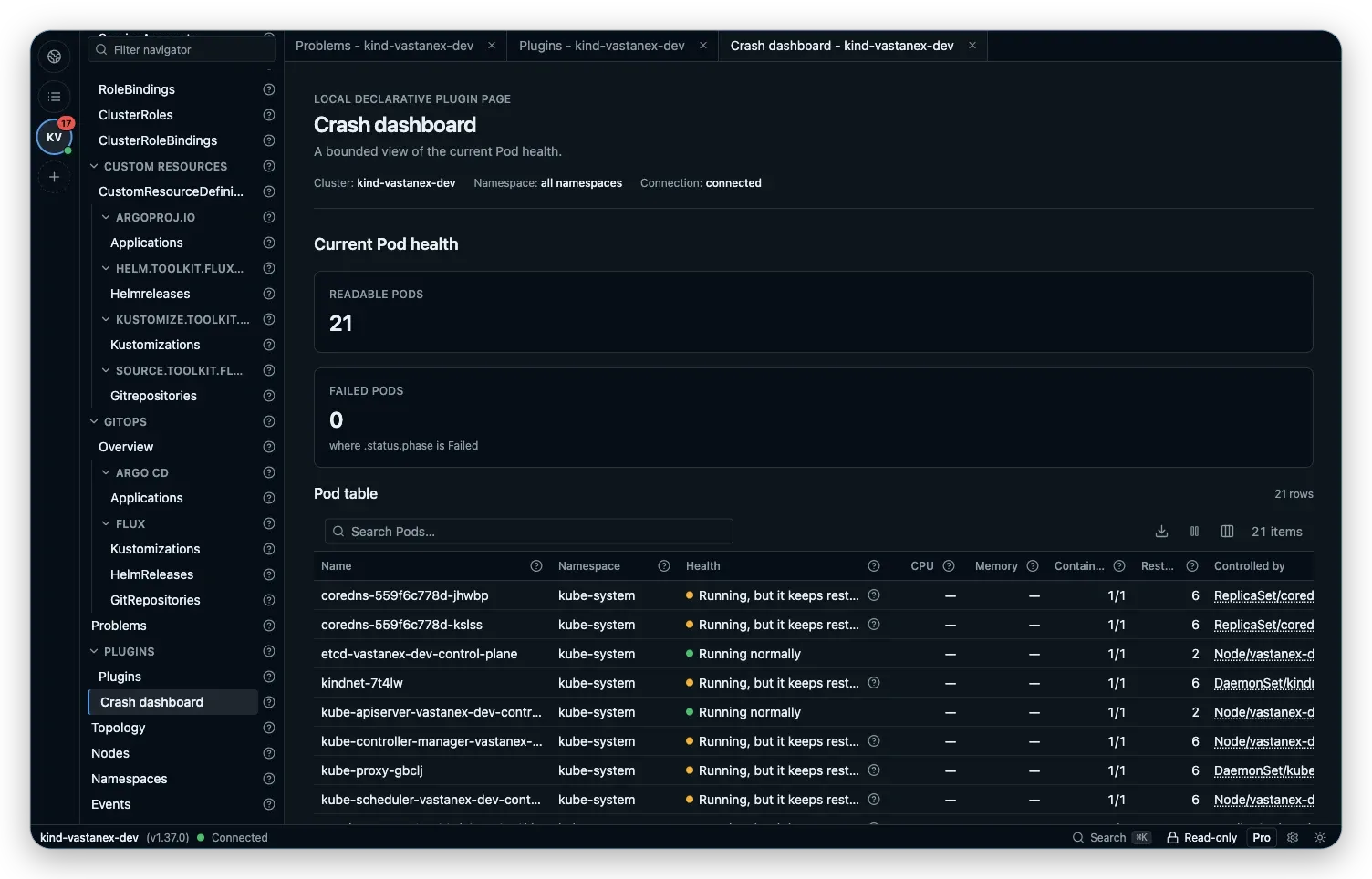
A Page has a declared scope
The local crash-explainer.yaml fixture declares a Crash dashboard for Pods. Its Page shows a
current health heading, a readable Pod count, a failed count and a Pod table. The app labels the
cluster, namespace and connection state at the top, so “current” has a visible scope rather than
being an unqualified fleet claim.
The footer states the other important boundary: reads are limited to declared, discovered kinds and the current namespace scope. Tables cap and virtualize 5,000 objects. If discovery, a source or the connection is partial, unavailable or disconnected, that state stays visible. A declarative Page is therefore a bounded view over the API data it was allowed to discover, not a general query language or a hidden cross-cluster traversal.
The Page does not execute JavaScript from the YAML. Its widgets come from a fixed catalog, and the same current cluster and namespace selectors that govern the rest of the app continue to apply. That makes a local file useful for a team convention without turning every file into an extension runtime.
Add detail without hiding the object
The same fixture adds a DetailSection to the selected crasher Pod. The section shows its
Phase and a bounded Explanation value. The raw object, standard Properties, Events and other
drawer sections remain separate. The declarative section adds context; it does not replace the
Kubernetes object or claim that the text is a diagnosis.
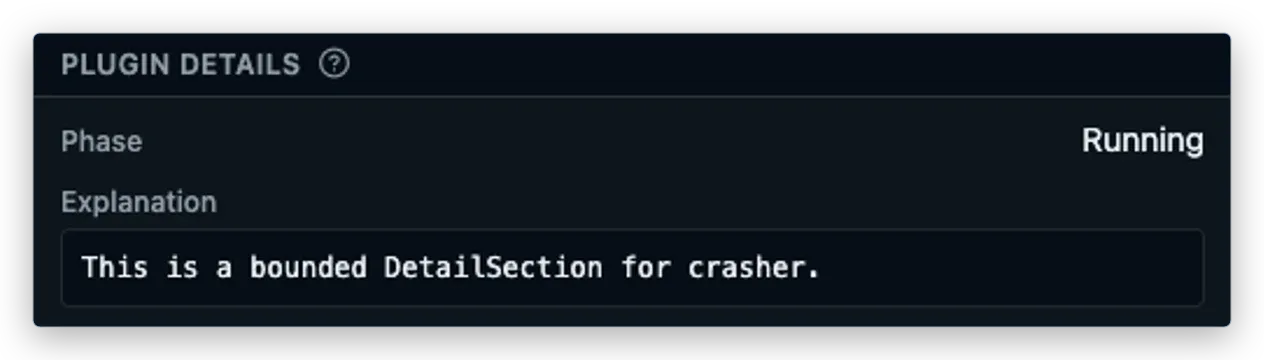
The detail heading identifies the section as plugin-provided. Values are rendered as text, tables, badges or preformatted blocks from the supported component types. There is no arbitrary markup in the value, and a detail component does not gain write access merely because it appears beside a resource.
Review a Safe Action before it can write
The fixture also declares Acknowledge crash, a Safe Action that can add one exact annotation to the selected Pod. The action is not offered as a bulk command. A per-file grant makes write intent explicit, the selected object is checked again in the main process, and the API request follows the fixed action definition.
The first confirmation opens a review. Vastanex asks the server for a dry-run and shows the exact
selected-object patch. In this capture, the patch is the one annotation path from ∅ to true.
The dialog is left open with Cancel visible; the capture never applies it.
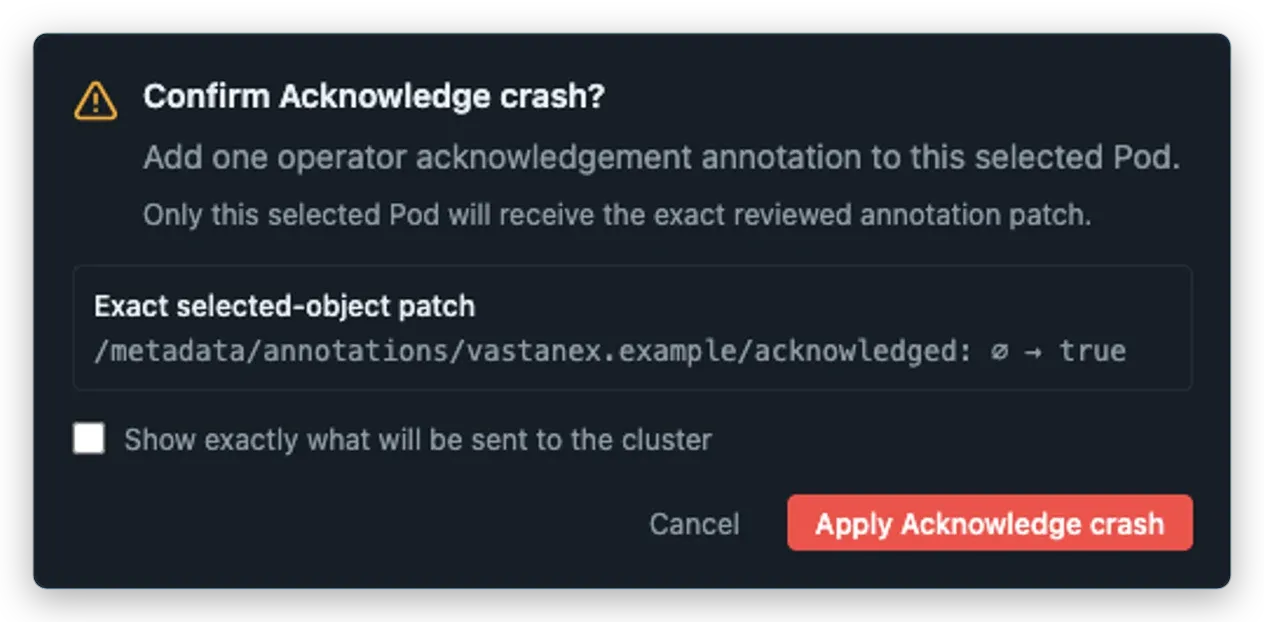
This ordering is useful for a small team: someone can inspect the intended patch, compare it with the selected object and stop before a write. A successful dry-run is not proof that the eventual write will complete, and the action remains subject to Kubernetes RBAC and connection state. The
Kubernetes API concepts
describe the server-side API boundary that the app still has to respect.
What it does not do
Declarative plugins are not a marketplace, arbitrary code execution, a network client or a way to read Secret bodies into a page. Pages do not promise every Kubernetes resource, unlimited object traversal or a bespoke query language. DetailSections do not infer causes. Safe Actions do not bypass RBAC, apply an unreviewed bulk mutation or turn a cancelled screenshot into a production change. The examples use a disposable local fixture and a selected local Pod.
Try the Download page to see the current desktop availability, then compare these bounded extensions with read-only-by-default controls or the server-side YAML review path.