
“The cluster is full” can mean several different things. A Node may have allocatable capacity left while requests reserve most of it. A container may have a limit that is much higher than its current usage. A metrics provider may be partial or unavailable. Treating those values as one number makes an operational question sound more certain than the evidence allows.
Vastanex Capacity and operations keeps the values side by side. It labels the metrics source and evidence state, separates current provider readings from Kubernetes declarations and keeps insights tied to the objects the app actually read.
Read usage beside the declarations
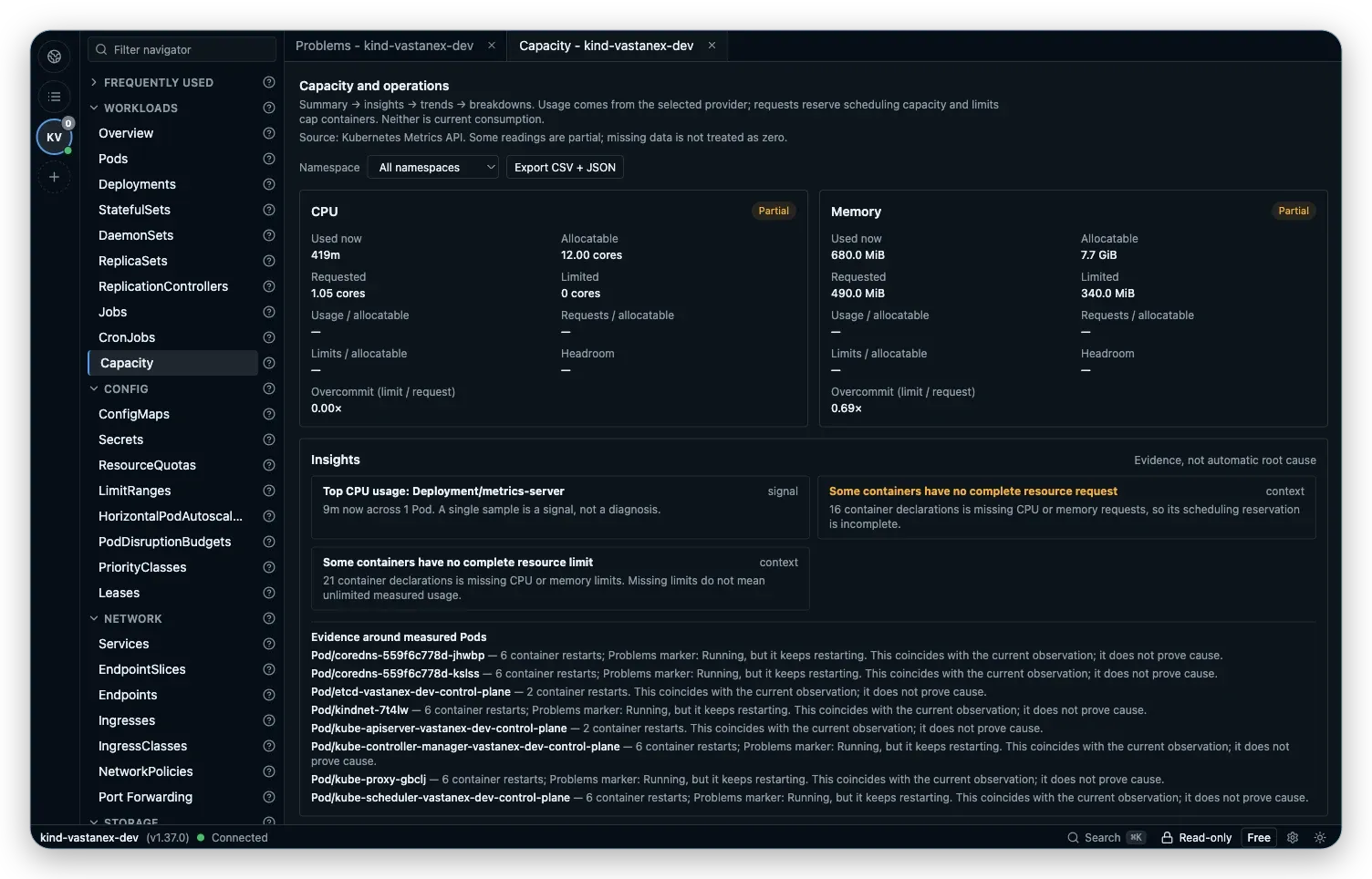
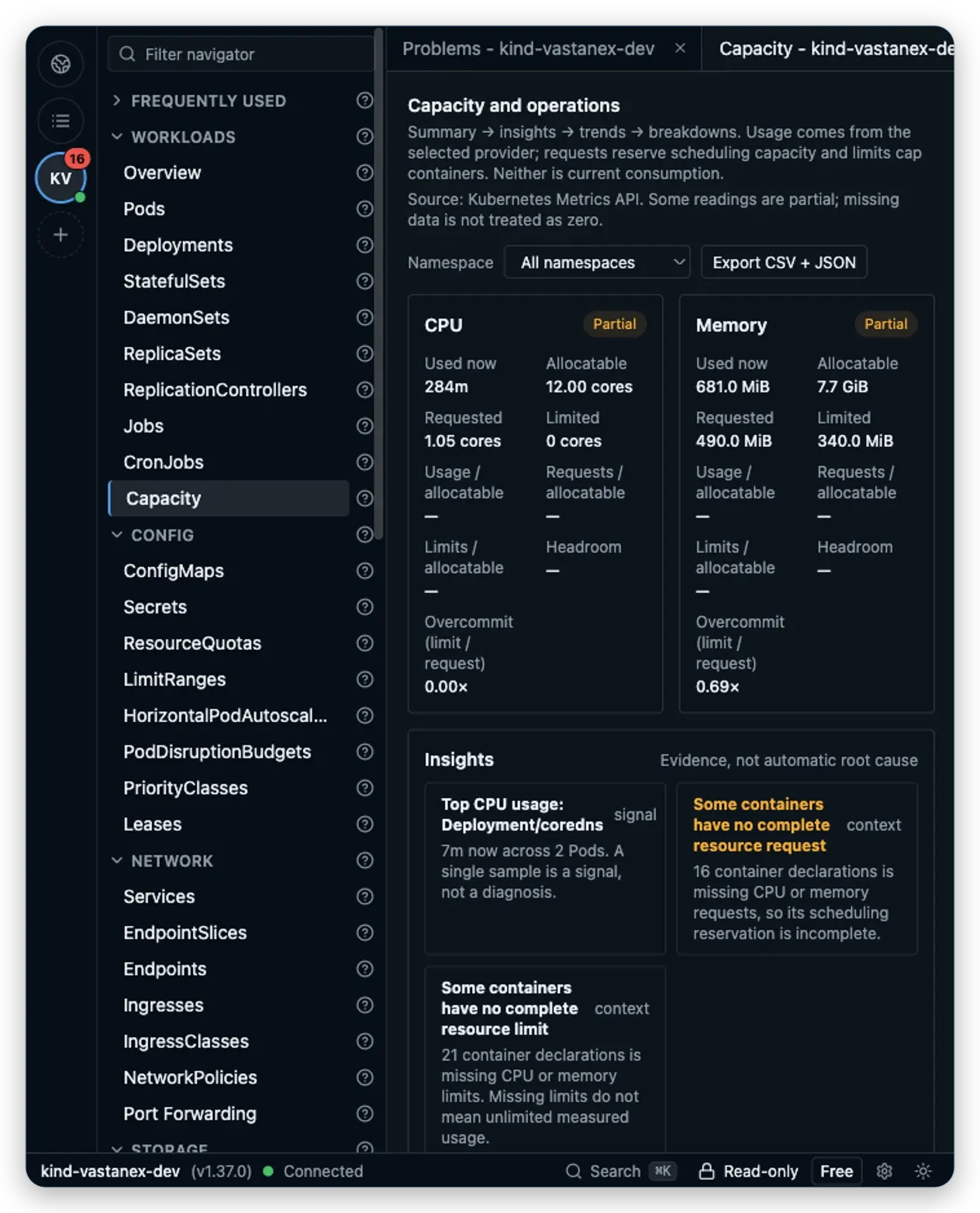
The Capacity view shows CPU and memory cards for the selected namespace scope. Used now comes
from the selected metrics provider. Allocatable is what Nodes report as available to workloads.
Requested values describe scheduling reservations, and Limited values describe container
caps. Requests and limits are not current consumption, and a missing ratio stays — instead of
being invented.
The source line says where the reading came from. On this local run it is the Kubernetes Metrics API, and the cards are marked Partial because some derived values cannot be completed from the available response. A different cluster can show Current or Unavailable. The page keeps that provider state visible rather than promising that metrics are always installed.
The export control writes the bounded Capacity evidence as CSV and JSON. That is useful for a review note or a short comparison, but it is not a time-series archive. The selected namespace, source status and range remain part of the evidence context. That distinction matters when a namespace looks busy: reservations can be high while actual use remains low, or a current reading can be missing entirely.
Use ranked signals carefully
The insights section ranks signals such as top usage, missing requests or missing limits. It also shows evidence around measured Pods: exact owner links, restart counts, Problems markers and the current reading when those pieces are available. The wording is intentional: Evidence, not automatic root cause.
A restart that coincides with a high reading is worth investigating. It does not prove that the reading caused the restart. A Pod without a complete owner chain stays in its own bucket. A provider sample that is partial does not become zero, and an absent sample does not become a healthy green card.
This view is designed to put the next question in reach: inspect the named object, read its Events and logs, compare requests with the workload’s specification or check the provider that supplied the measurement. It is not designed to choose a remediation automatically.
Keep cost optional and provider-backed
Cost context is a separate panel. It can report an existing OpenCost or Kubecost provider’s source, currency, estimate and time window when that provider is present and readable. Vastanex does not make up a price from CPU or memory usage, and it does not turn a capacity signal into a savings claim.
The local fixture has no supported cost provider. The honest result is the visible unavailable message below. That state is useful evidence too: it tells the reader why there is no currency or estimate, rather than filling the gap with a plausible-looking number.

The Kubernetes resource management documentation is the authority for requests and limits themselves. Vastanex adds an evidence-oriented view over the current cluster responses; it does not replace Kubernetes scheduling or a cost system.
What it does not do
Capacity is not a guarantee that a workload will schedule, a forecast of future demand or an automatic root-cause engine. Metrics can be absent, partial, stale or bounded to a provider’s range. Requests and limits are not usage. Correlation with restarts or Problems is not causation. Cost stays unavailable without a supported provider, and no price, currency, savings or chargeback number is inferred.
Try the Download page to see the current desktop availability, then start with a Problem and its evidence or inspect bounded declarative extensions.